C:\1990S\NETSCAPE.TXT
1994
Netscape Navigator: The Browser Remembered a Small Thing
Navigator 1.0 helped make the web a place for ongoing transactions, with cookies carrying small pieces of state between separate requests.
A customer selects a notebook in an online shop, then opens another page to examine a pencil. The shop needs to remember the notebook. Otherwise, it has built a catalog with an unusually strict one-item attention span.
The pages are separate requests. The customer experiences one visit. Connecting those two perspectives is part of making the web useful for something beyond retrieving documents.
Netscape Navigator’s early history includes a particularly small answer: let the browser keep a piece of information and return it with later matching requests. A cookie could carry the connecting token. The server could then recognize which basket to update.
That modest exchange changed the relationship between browser and service. The browser wasn’t merely collecting pages; it could help preserve continuity across them. The important engineering question became what it remembered, where it sent that information, and what the receiver was entitled to infer.
A commercial browser, with qualifications
Netscape’s December 15, 1994 announcement states that Navigator 1.0 was available, with a $39 single-user commercial license. Academic, nonprofit and evaluation downloads were free under their stated conditions. The company had been founded in April by James H. Clark and Marc Andreessen.1
Those details are more useful than describing Navigator as simply free. Distribution and licensing had several categories, and the categories mattered to its proposed business.
The release also paired browser and server products in a pitch for online commerce, including SSL-based secure communication. Its common interface covered Windows, Macintosh and X environments. The announcement’s speed and security superlatives are marketing claims, rather than measurements or guarantees.1
An earlier product page advertised simultaneous image loading, streaming display, caching and native JPEG decoding. It also predicted November shipment and a $99 price. That page records the plan; the actual December announcement controls the shipping date and price used here.2
I find the combination more revealing than any advertised multiplier. Useful browsing required more than obtaining the right bytes eventually. Pages had to become readable, navigation had to remain understandable, and repeated interactions had to feel connected. Improving one of those jobs didn’t abolish the others.
This article follows the state problem. Judson Valeski’s later Netscape engineering account explicitly says cookies were introduced in Navigator 1.0. Its 1998 implementation details aren’t all features of the 1994 browser.3 In particular, the following exchange needs no JavaScript. Server and browser handle its headers.
A request doesn’t carry a basket automatically
Here is an invented stationery shop at the reserved demonstration address shop.example. Two visitors are browsing independently. One wants a notebook; the other wants envelopes.
If both request /shop/cart, the path alone doesn’t tell the server whose basket to display. It identifies the kind of resource requested, without supplying a complete history of the person making the request.
The server can assign a token and associate it with its own record. In our example, token 17 identifies the first basket and token 23 identifies the second. These deliberately small numbers are teaching values, not a recommendation for real authentication tokens.
When the first visitor receives a response, the server includes:
Set-Cookie: cart=17; path=/shopThe browser stores the name and value with the cookie’s scope. When it later requests /shop/cart from the same host, it can include:
Cookie: cart=17The original Netscape specification defines this response-header/request-header relationship, path scope, session expiry when no expiry is supplied, and the optional secure restriction. Its path comparison is prefix matching, rather than the later rules a modern browser tutorial might assume.4
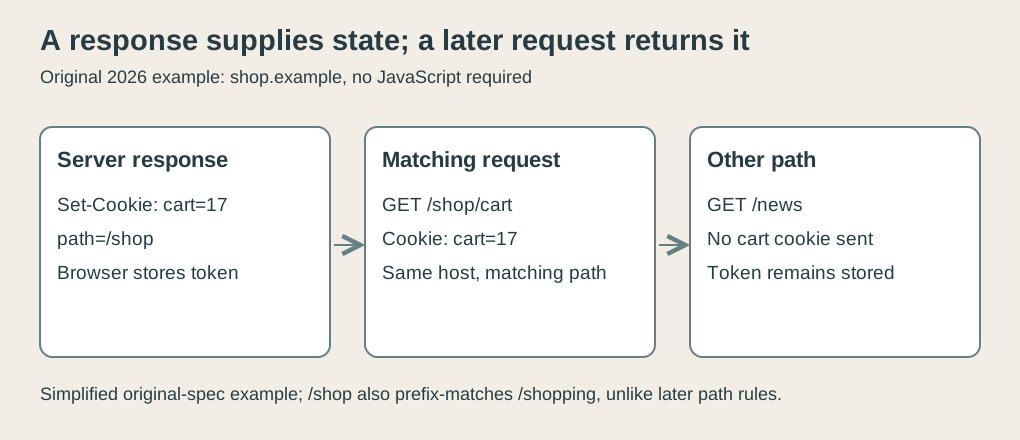
Original explanatory diagram, 2026. Invented shop and token, simplified headers; not a Navigator screenshot or captured network traffic.
The basket doesn’t have to be inside the cookie. Here it stays on the server:
| Token | Server-side basket |
|---|---|
17 | One notebook |
23 | Two envelopes |
The cookie is a reference, not a receipt. Reading cart=17 tells the server which record to consult. It doesn’t, by itself, describe the items, their prices or whether the customer has paid.
This separation keeps the example easy to reason about. The browser remembers one short value. The service manages the changing contents. Adding a pencil can update the server’s basket without requiring the cookie to contain an ever-growing list of stationery.
Follow the two visitors
Let’s give our visitors names: Maya and Theo. Their browsers have separate cookie stores. Maya receives cart=17; Theo receives cart=23.
Maya requests /shop/cart. Her browser sends the first value, and the service finds the notebook. Theo requests exactly the same path, but his browser sends the second value, and the service finds the envelopes.
The URLs are identical. The request context differs.
Maya adds a pencil using another shop request. Our teaching service updates record 17 to contain one notebook and one pencil. Theo’s record remains unchanged. A later request carrying cart=17 retrieves the updated basket.
The cookie hasn’t gained any knowledge of pencils. It continues to identify the record. This is the point at which a browser’s small stored value becomes useful: it gives separate requests a stable point of reference while more substantial state changes elsewhere.
Now Maya requests /news. The /shop-scoped cookie isn’t sent in our model. The news page therefore doesn’t receive that basket token through this cookie rule. Return to /shop/cart, and the token applies again.
That scope is part of the information’s routing. It doesn’t mean the browser has forgotten the basket when it opens the news page. The cookie can remain stored while being withheld from a particular request.
Our checker verifies those cases using a simplified host-exact, path-prefix model. It checks two separate browser stores, a server-side update and the distinction between stored and sent. It isn’t a recovered Navigator executable or a comprehensive cookie implementation.
A prefix isn’t a directory permission
There is a detail worth making explicit because modern knowledge can lead an explanation astray. Under the original specification’s prefix rule, path /shop also matches /shopping. The text itself illustrates this kind of matching with another path. A slash boundary isn’t required by that historical rule.4
Our checker consequently expects the token on /shopping, as well as /shop/cart. It does not expect it on /news.
This can surprise readers who interpret a path scope as a filesystem directory. A URL path is a string being compared under a protocol rule. Its familiar punctuation doesn’t automatically import the operating system’s meaning of a directory.
The distinction also limits what scope can prove. An application shouldn’t assume that a path label constitutes a complete authorization boundary. Routing a token to selected requests and deciding whether a requester may perform an action are separate jobs.
For clarity, the main basket example keeps all requests on one exact host. It doesn’t model the original specification’s broader domain matching, multiple competing names, persistence bugs, storage limits or expiry parsing. Those deserve their own tests before anyone claims a complete implementation.
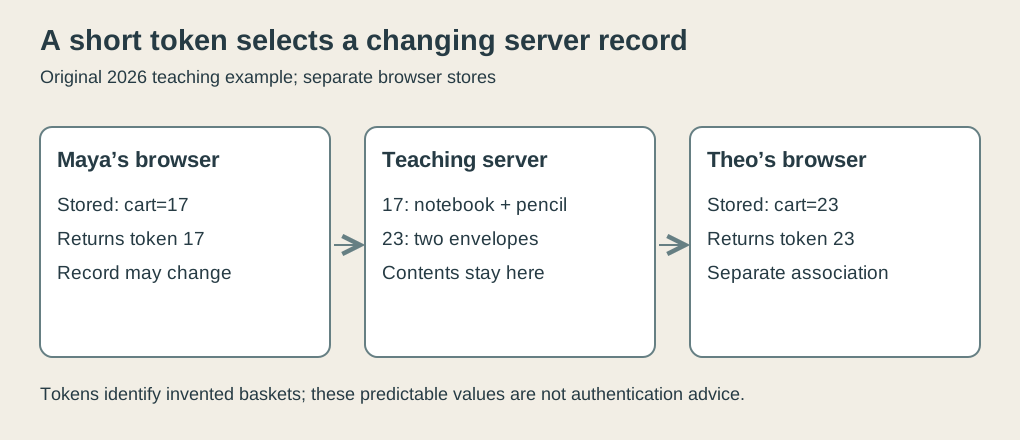
Original explanatory diagram, 2026. Maya’s invented token selects basket 17; Theo’s separate token selects basket 23. Data remains on the teaching server.
Remembering isn’t identifying a person
A cookie value can connect requests without proving who is making them. Our service recognizes a basket token. It hasn’t authenticated Maya’s legal identity, verified an address or established permission to charge a payment card.
That distinction becomes concrete if somebody presents Theo’s token. In this intentionally naive model, presenting 23 selects Theo’s basket. The number is predictable and the service trusts it. The demonstration shows why a useful continuity mechanism is not automatically a secure authorization design.
There are further failure cases even without an attacker. Clear Maya’s browser store, and a later cart request no longer carries 17. The server might still possess the notebook-and-pencil record, but it has lost this particular connection to the visitor’s next request.
Open a different browser with an empty store, and it doesn’t automatically inherit Maya’s basket either. Conversely, two people using the same browser state may share the same token. A cookie tracks a stored association, which may not correspond neatly to one human being.
The ordinary phrase “the website remembers you” compresses all of these distinctions. It might remember a basket, an account session, a preference or simply a repeated token. What the token refers to is a decision made by the service.
That flexibility is useful and consequential. The same continuity that avoids reselecting a notebook can support the collection of a browsing history. Evaluating the mechanism requires asking which observations are linked and for what purpose, rather than treating remembering as inherently friendly or inherently malicious.
The channel is another job
The release’s commerce pitch included secure communication. A protected channel addresses exposure during transmission; it doesn’t make the contents of a basket accurate or turn a token into a verified identity.
Even in a hypothetical perfectly protected connection, our sequential 17 and 23 values would remain a poor authorization design. Encryption can’t repair a service that accepts the wrong evidence of permission. Equally, carefully designed application state can still be exposed if transmitted without appropriate protection.
The layers interact, but their obligations are distinct. The browser selects information for a request. The channel carries it. The service interprets it and decides what to allow. An attractive shopping interface doesn’t remove any of those responsibilities.
For the original Navigator milestone, this is a more useful interpretation of “commerce” than pretending a product announcement had settled every security problem. It brought practical mechanisms together and made a broader kind of service plausible. The quality of each service still depended on what its builders did with them.
A small memory with substantial consequences
The notebook survives the trip to the pencil page because the requests now have something in common. A few characters carried by the browser connect them to a record that can change over time.
That is a compact mechanism with a wide reach. It helps explain why web browsing could develop into interaction with an ongoing service, while also explaining why identity, privacy and permission required further thought.
The token doesn’t need to understand the customer. The people designing the service do.
Footnotes
-
Netscape, December 15, 1994 Navigator 1.0 shipping announcement, preserved original release. Date, $39 commercial price, free-use categories, founders, platform interface and SSL commerce pitch; promotional first/speed/security claims not adopted as verified facts. ↩ ↩2
-
Mosaic Communications, original Netscape product page, 1994 prerelease description. Features advertised there are identified as such; its predicted November/$99 terms aren’t the actual launch terms. ↩
-
Judson Valeski, netlib Cookies, 1998, opening historical statement linking cookies to Navigator 1.0. Later JavaScript filters and implementation details aren’t projected backward. ↩
-
Netscape, Persistent Client State: HTTP Cookies, original preliminary specification, preserved by curl. Selected header, scope, session and secure rules; the modern original checker is deliberately narrower than the full specification. ↩ ↩2