C:\2000S\IPHONESD.TXT
2008
The iPhone SDK: Building and Distribution Meet at a Gate
The 2008 iPhone SDK and App Store joined native tools, touch-driven application design and a controlled route from a developer's build to a user's phone.
A new application platform needs more than a processor capable of running programs. Developers need interfaces to the device, tools for constructing and inspecting applications, and a practical route by which another person can obtain the result.
Apple’s March 6, 2008 announcement introduced the beta iPhone SDK and described a forthcoming App Store. The tools included Xcode, Interface Builder, Instruments and a simulator on the Mac. Access to device testing during the beta involved the developer program.1
By July, Apple’s announcement about the store’s first weekend described applications reaching users through wireless downloads or iTunes synchronization.2
Those are different milestones. The SDK announcement wasn’t the same event as an operational public store. A development environment and a distribution channel answered different questions, even though Apple designed them as connected parts of one proposition.
The result made the phone a target for third-party native software while placing a gate in its route to users. The programmer could build behavior for the device; Apple also required approval for the announced store distribution path.1
Tools divide the work of making an application
Editing source, arranging an interface, examining performance and testing execution are related tasks, but they aren’t identical. A tool suite can give each a useful place in the development process.
An interface editor helps make a screen tangible. A debugger helps relate observed behavior to the program. A performance tool helps investigate where time or resources go. A simulator lets some behavior be tried without treating every small experiment as a physical-device session.
The existence of those tools doesn’t establish that the application is correct. A screen can look persuasive while its interaction fails. A successful launch can conceal a slow operation. A simulator can reproduce some behavior without proving the full experience on hardware.
That last boundary is particularly important for a phone. Real input, sensors, memory and network conditions can differ from a development machine’s environment. Testing needs to identify what has actually been exercised.
No historical SDK is installed for this article. The worked examples run on modern Python and model specific mechanisms. The release sources establish which tools were announced; the model outputs don’t stand in for an iPhone benchmark.
Touch turns a position into an intention
An application can receive a touch location and decide which on-screen object it refers to. That decision is a small piece of geometry attached to a larger interaction.
Invent a rectangular control whose upper-left corner is (20, 40), width is 100 and height is 30. Use half-open bounds: x from 20 through values below 120, y from 40 through values below 70.
A touch at (50, 55) is inside. A touch at (119, 69) is also inside. A touch at (120, 55) is outside, because it lies at the first horizontal coordinate beyond our chosen interval.
inside = 20 ≤ x < 120 and 40 ≤ y < 70The convention prevents an edge from belonging to two adjacent half-open rectangles in this flat model. It isn’t a claim about an exact UIKit hit-testing method or the original SDK’s coordinate units.
Our check evaluates those points directly. It also checks a touch at (19, 55), which lies just to the left and is rejected. All values are invented, and no physical touch screen is measured.
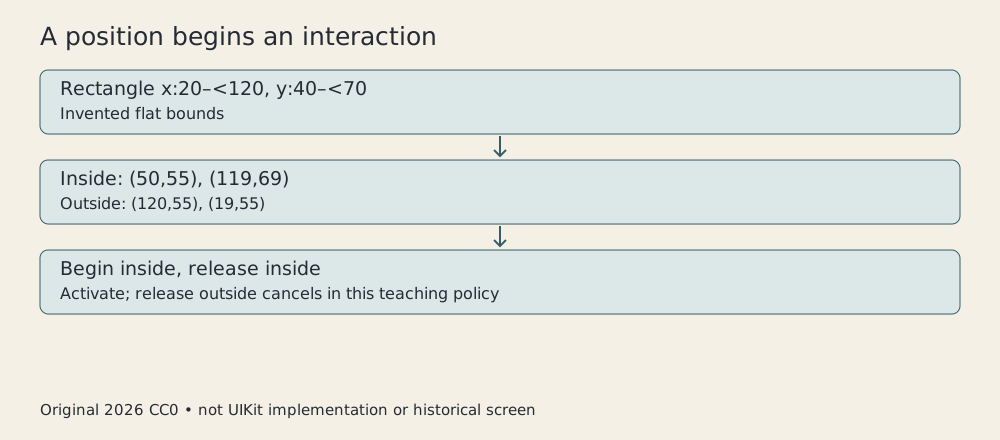
Original CC0 diagram, 2026. Simplified rectangular test, not UIKit code or a period iPhone screen.
Geometry alone doesn’t settle intention. A person can begin a touch inside a control and move out before releasing. They may be scrolling the surrounding view or changing their mind. An application has to decide which sequence constitutes activation.
That makes input an event history, rather than merely one coordinate. The beginning, movement and ending can affect the result. A small model can make that requirement visible without pretending to reproduce the entire operating-system recognizer.
A press can be cancelled before it commits
Give our invented control three states: idle, tracking and activated. A touch beginning inside starts tracking. A release inside while tracking activates it. A release outside cancels the operation and returns to idle.
The first test begins at (50, 55) and ends there. It activates once. The second begins at the same location and ends at (150, 55). It cancels and performs no activation.
The model also rejects an ending event with no tracked beginning. The application shouldn’t treat every isolated release as though it completed an accepted interaction.
This sequence models one possible control policy. It omits multiple touches, movement thresholds, interruption and the real platform’s responder system. Those omissions are recorded rather than quietly filled with present-day framework behavior.
The useful idea is commitment. The application distinguishes an interaction in progress from the action it will finally perform. A visual pressed state can provide feedback without claiming that the underlying task is already complete.
A second layer begins after activation. If the action saves a record or contacts a server, success still needs its own acknowledgment. Completing the gesture doesn’t guarantee completing the task.
The distinction echoes earlier web applications, but the input context differs. A phone’s small screen and direct touch make the relationship between visible object, gesture and resulting action particularly immediate.
State has to survive interruptions meaningfully
Imagine an invented note-taking application. The user enters Pier inspection and has not yet saved it. An interruption now creates a question: which state should be available when they return?
A model that stores only committed notes loses the current edit if its transient state disappears. A model that separately records a pending draft can restore the text while continuing to distinguish it from a finished saved note.
Our check records a pending draft, clears the model’s current editor value and restores it from the draft record. It confirms that the committed-note list remains empty. Restoration doesn’t accidentally claim the user completed the save.
This is a general lifecycle model, not a statement about one specific 2008 callback or background privilege. The application decides which state to preserve, and the platform determines which opportunities and resources it has for doing so.
Later iPhone OS releases changed those opportunities. Apple’s 2010 preview explicitly introduced multitasking features.3 Those later facilities aren’t assigned to the original third-party platform merely because modern mobile developers expect them.
Keeping the boundary dated prevents an attractive but false account in which the first SDK already contains everything subsequently learned about mobile applications. The initial platform was consequential without being the final one.
A build and a distributed application have different status
A development build can exist and run in a test environment before the public can obtain it. Store approval and publication introduce further states between making the application and delivering it.
Our simplified model uses built, submitted, approved and available. A built application isn’t automatically available. An approved application isn’t treated as installed on every device. Each transition represents another decision or operation.
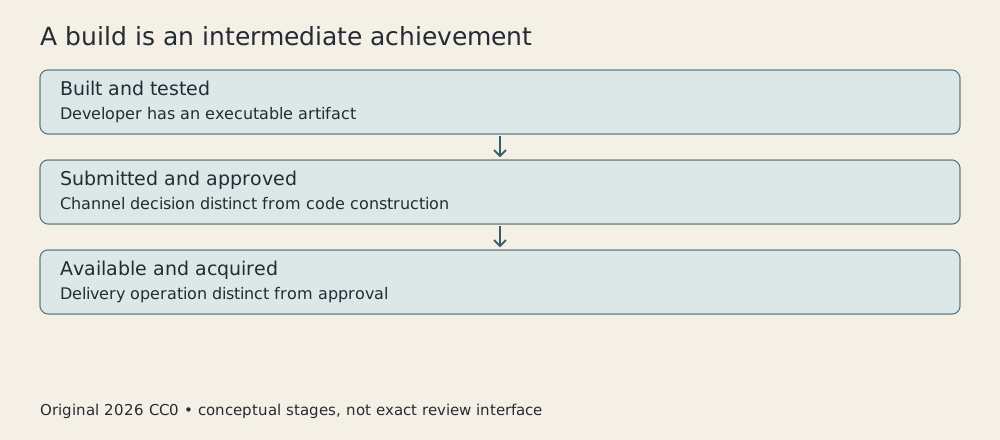
Original CC0 illustration, 2026. Conceptual store workflow, not an exact 2008 submission interface or review policy.
The gate has practical benefits and constraints. A shared channel can simplify discovery and acquisition. It also gives the channel operator authority over what reaches users through that route.
The March announcement states the approval requirement; it doesn’t provide the evidence needed to reconstruct every later dispute or rule. This article therefore doesn’t present today’s store policies as though they were a complete 2008 contract.
Steve Jobs was the public executive voice in that announcement. The actual platform depended on the teams making its operating system, tools and store, as well as developers producing applications. A quoted executive isn’t the sole author of those systems.
The distribution contract enters the arithmetic
The announced arrangement let developers set prices, including free, and retain seventy percent of sales revenue.1 That creates a simple period teaching calculation, with deliberately limited assumptions.
At an invented price of $2.99 and one hundred sales, gross revenue is $299. Seventy percent is $209.30; the remaining thirty percent is $89.70. Our Decimal check verifies those amounts without floating-point rounding surprises.
These are hypothetical sales, not an actual developer’s earnings. The calculation excludes taxes, refunds, adjustments, development expense and every other contractual detail. It illustrates the announced split and offers no current pricing or financial recommendation.
A free application produces no sales revenue in that model even if many people download it. Acquisition count and income are different quantities. A distribution channel can widen reach without making every project commercially successful.
The same caution applies to the July announcement’s download total. A publisher’s reported aggregate doesn’t establish how any individual application performed, whether its users kept it or how well it worked. No such inference is made here.
The phone becomes a distribution target
The July source describes store browsing, account-based purchases, updates and acquisition through the device or desktop iTunes.2 Delivery was part of the user experience rather than a separate hunt for an installer.
That matters to a developer because the useful end state is another person running the application. Source code and a successful local build are intermediate achievements. Tools can make those achievements easier while a store makes the final route more legible.
The 2008 milestone joined both sides of that relationship. APIs and tools opened native development; a controlled channel organized acquisition. Touch-driven interaction supplied new application possibilities, while lifecycle and distribution rules constrained how they were realized.
Our examples isolate the obligations that remain: interpret an input sequence, preserve the right state, distinguish a test build from public delivery and understand the announced commercial division. None disappears because the platform supplies a convenient tool.
An application platform is partly a promise about what can be built and partly a route for getting it into somebody’s hands. In 2008 those two promises became closely coupled on the iPhone. The gate was part of the architecture.
Sources
Footnotes
-
Apple, Apple Announces iPhone 2.0 Software Beta, March 6, 2008. SDK/tools/program, approval and announced revenue arrangement; projected dates distinguished from actual availability. ↩ ↩2 ↩3
-
Apple, App Store first-weekend announcement, July 14, 2008. Operational acquisition/update routes; no individual-app success inferred from publisher totals. ↩ ↩2
-
Apple, Apple Previews iPhone OS 4, April 8, 2010. Later multitasking boundary, not a 2008 capability. ↩