C:\2010S\SLACK.TXT
2014
Slack: Put the Conversation Somewhere Findable
Slack's 2014 commercial launch made workplace conversation, files and machine notifications share a searchable place, with new burdens of attention and access.
The new colleague asks why the release was delayed. Somebody remembers a conversation. Somebody else remembers the opposite conclusion. The person who made the decision is on holiday, and the relevant email was sent before the new colleague joined.
A chat window alone does not solve this problem. It can supply another place to have the same conversation and another place to lose it.
Slack’s consequential arrangement was to put workplace discussion into named channels, retain it for later retrieval and let other software contribute to the same stream. The conversation could become part of a team’s working memory rather than a sequence of private deliveries.
Its public commercial launch was February 12, 2014, following the invited use of 2013. Early employee James Sherrett identifies the date in his participant account and distinguishes the paid product from the continuing free version.1 This article concerns that launch year, not every feature later placed under the Slack name.
The distinction matters because an appealingly tidy modern screenshot can make the first version look as though it already had all the tools needed to tame what it was encouraging.
Change the address of the conversation
Email gives a message a set of recipients. Those recipients may forward it, add somebody to a reply or keep copies in their own mailboxes. A channel gives discussion a place organized around a subject or group.
That changes what a later arrival can reasonably hope to find. An invented development team has a channel called release, a channel called support and a private staffing discussion. The names are conceptual labels here, not a recreation of a particular company’s Slack configuration.
On Monday, a developer proposes delaying release until a migration check is finished. Another developer posts the failed check. On Tuesday, the lead approves the delay and names the check that must pass before work resumes.
If those three events are addressed to a shared release space, the relationship between proposal, evidence and decision has somewhere to persist. A new teammate with appropriate access can examine that record rather than asking three people to reconstruct it from memory.
This is a modest kind of institutional memory. It is not a guarantee of accurate documentation. People can still post ambiguous decisions, attach outdated files, use an unhelpful channel or hold the important conversation elsewhere.
The channel makes a useful arrangement possible. Its members have to supply the content and the context.
A search needs more than a promising word
Here is an original miniature archive, represented as six fictional records. Each has an identifier, a location and some text:
1 release   migration check failed
2 release   delay release until migration passes
3 release   migration passed; release approved
4 support   customer asks about migration date
5 staffing  migration training affects hiring plan
6 release   lunch delivered
A literal search for migration produces five matches. Restricting the query to the release location reduces that to three. The third result reports approval, but the first and second explain what had been blocking it.
The companion Python check performs those operations on an in-memory list. It is an original model of filtering an archive, not a Slack search-engine reimplementation. No ranking, stemming, interface syntax or historical API response is inferred from it.
Now give a new teammate access to release and support but not staffing. Searching the accessible records for migration produces four matches: records one through four. The staffing result does not become appropriate to reveal merely because it matches the same word.
The model makes two separate requirements visible. Search must help identify relevant material. It must also respect the boundary around material the person can retrieve. Excellent keyword matching would not compensate for showing a private staffing discussion to somebody outside it.
Nor does the last matching message automatically settle the question. The third record says the check passed; a subsequent incident could make that approval obsolete. A result needs its surrounding history and its date. Search retrieves evidence from an archive. It does not confer permanent authority on every sentence in it.
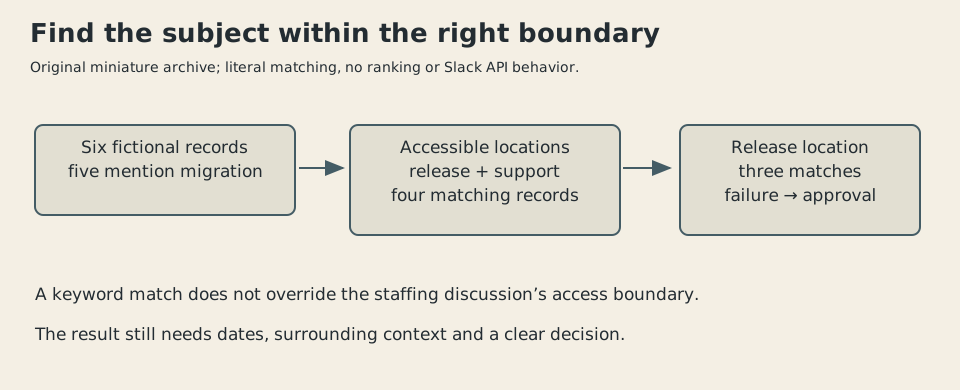
Modern explanatory diagram, drawn in 2026. Six fictional records illustrate retrieval and access; no Slack search ranking or historical interface is simulated.
The service boundary was part of the product
Slack’s archived November 24, 2014 security statement distinguishes team channels, private groups and direct messages. It also discusses storage, indexing, retention policies and the restricted operational access its own technical staff could require.2
That is a useful contemporary corrective to the casual idea that a team chat is simply a room whose occupants happen to be far apart. The room has a service operator, stored content, authenticated members and administrative rules.
Calling a discussion private to a team is a claim about an access boundary, not a claim that the words were never stored or that no operational role could ever handle them. The period statement expressly acknowledges the software that stores and indexes customer material.
The practical question for our fictional team is therefore larger than whether the new teammate receives notifications. Who belongs to the team? Which discussions are shared? Which records remain available? Who administers those choices?
A channel archive useful for onboarding can also contain material written for a narrower audience. Preserving more conversation increases the need to understand its intended audience. The same retention that saves a useful explanation preserves a careless aside.
This is not a reason to abandon a shared archive. It is part of what operating one means.
Software could speak into the same place
A particularly useful contemporary record is Jacob Harris’s account of election-night work at The New York Times. In a June 2014 interview, he described connecting election results to Slack through a webhook, so staff could watch incoming information on their phones as well as computers.3
The important mechanism is the connection between a source of events and the location where people discuss those events. A program produces a change. An integration presents an account of that change to the relevant group.
For our release team, an automated check might contribute migration check failed to the release channel. A person can then explain the failure and decide whether to delay. A later check can report success. Machine output and human interpretation acquire a common sequence.
The integration need not replace the source system. A concise notification can point to the authoritative build record, where the full log and artifact live. That division is useful: the channel provides awareness and discussion; the build system retains the detailed evidence appropriate to its job.
The arrangement can go wrong in familiar ways. A notification lacking a build identifier might be mistaken for the wrong run. A repeated alert can fill the stream without adding information. A successful transmission says an event was posted, not that somebody understood it or completed the necessary work.
These are interface and workflow problems as much as transport problems. Connecting two programs is the beginning of designing a useful integration.
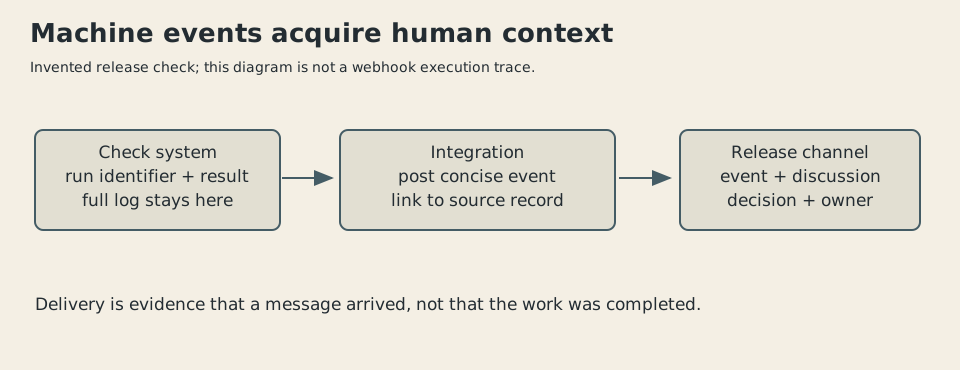
Modern explanatory diagram, drawn in 2026. The invented release check is not an executed webhook or a historical deployment record.
Fast discussion can manufacture slow work
An archive is useful partly because people do not have to read everything at the instant it arrives. Yet a live chat interface can exert precisely that pressure.
In the fictional release channel, the migration failure matters to a few people immediately. The eventual decision matters to more people. Six jokes and an unrelated question posted between them can make the stream feel active while making the outcome harder to extract.
Splitting every small discussion into its own channel creates another problem: people must discover which location contains the answer. Keeping every discussion in one channel makes that answer harder to distinguish. The organizational work has not vanished. It has moved into names, boundaries and habits.
A useful decision message should consequently carry more information than okay. For example: release delayed until migration check passes; owner named; relevant run linked. That statement can be interpreted later by somebody who did not watch the conversation happen.
Search benefits from that clarity too. A message with the actual subject and decision gives a later query something to retrieve. A perfect index cannot find a word that nobody supplied or reconstruct a condition that everyone assumed at the time.
A later solution belongs to a later year
Slack introduced Threads publicly on January 18, 2017. Product engineer Paul Rosania’s account says the first prototype began in late 2015 and describes how testing changed the design.4 Threads should therefore not appear as an available cure for launch-year channel traffic.
The later feature also demonstrates how much design lay inside the apparently simple act of replying. Linking responses did not by itself make busy channels clear. Placement, visibility and expectations about who should follow a discussion all mattered.
Likewise, Slack engineers’ 2019 explanation of shared channels describes the original workspace as the boundary around users, channels and stored data from the 2014 launch. Cross-organization sharing required them to revisit that assumption.5 A shared channel spanning companies is a later development, not a launch-year synonym for an ordinary team channel.
These boundaries keep the original achievement in view. Slack made an existing kind of communication easier to organize, search and connect to other work. It did not arrive with the final answer to every consequence of doing that at scale.
For the new colleague asking why a release was delayed, the payoff is concrete. There may be a place to find the failed check, the discussion and the decision. They no longer have to begin by discovering which absent person remembers the right email.
They still need somebody to have written down what was decided. Even a very convenient memory needs something worth remembering.
Sources
Footnotes
-
James Sherrett, “Launching Paid Slack”, May 14, 2025. First-person participant retrospective; launch date and free/paid distinction, not independently audited growth statistics. ↩
-
Slack, archived security practices, effective November 24, 2014. Contemporary provider statement; its assurances are not a security audit. ↩
-
Joseph Lichterman, “Chatting with bots”, June 10, 2014, first-person interview with Jacob Harris about his integration. Used as a contemporary participant record. ↩
-
Paul Rosania, “Weaving Threads”, January 18, 2017; preserved page updated June 29, 2020. ↩
-
Yingyu Sun and Mike Demmer, “How Slack Built Shared Channels”, September 16, 2019; preserved page updated June 18, 2020. Retrospective account of the original boundary, not a launch-day backend specification. ↩