C:\2000S\AMAZONS3.TXT
2006
Amazon S3: Storage Becomes a Named Object
S3's 2006 launch offered an Internet storage interface organized around objects and keys, shifting capacity work away from the application's rented disk.
An application that accepts uploads needs somewhere to keep them. On a conventional server, that often means a filesystem with a capacity the operator has chosen, purchased or rented. When it fills up, the application has acquired an infrastructure problem along with its documents.
Amazon S3 launched on March 14, 2006 with an Internet-facing storage interface. The publisher’s announcement described writing, reading and deleting objects, identified by developer-assigned keys, with a launch limit of five gigabytes per object.1
The consequential change was the unit presented to the programmer. The application could ask the service to retain a named object without first arranging a particular disk, its partitions and its replacement plan.
This didn’t remove storage administration from the world. It moved much of that work behind a service boundary. The application still needed a way to name its data, decide who could retrieve it and cope when a request failed.
The address identifies a payload
Think of a simplified object store as a mapping from a namespace and key to some bytes and metadata. The programmer supplies the name; the service supplies operations for the corresponding object.
Our invented namespace is field-notes. Its keys include photos/pier.txt and reports/day-one.txt. The payloads are short text strings so the mechanism is easy to inspect without transferring photographs.
The slash in a key can help organize names, but it needn’t imply a physical directory hierarchy. In our teaching store, photos/pier.txt is one string used as a lookup key. There is no separate photos directory object whose disk blocks must be traversed.
Start with this object:
namespace: field-notes
key: reports/day-one.txt
payload: wind from west
metadata: author=Lee
A read using that namespace and key returns the payload. A different key doesn’t retrieve it merely because its spelling looks similar. Naming is part of the application’s data design.
Our modern Python check uses a dictionary to demonstrate this lookup. It is not an S3 emulator or a test of the service. No cloud account is created and no remote request is sent.
The model then replaces the payload under the same key with wind from north. There is now one current object at that key, containing the new bytes. Historical version retention is not implemented or attributed to the 2006 launch.
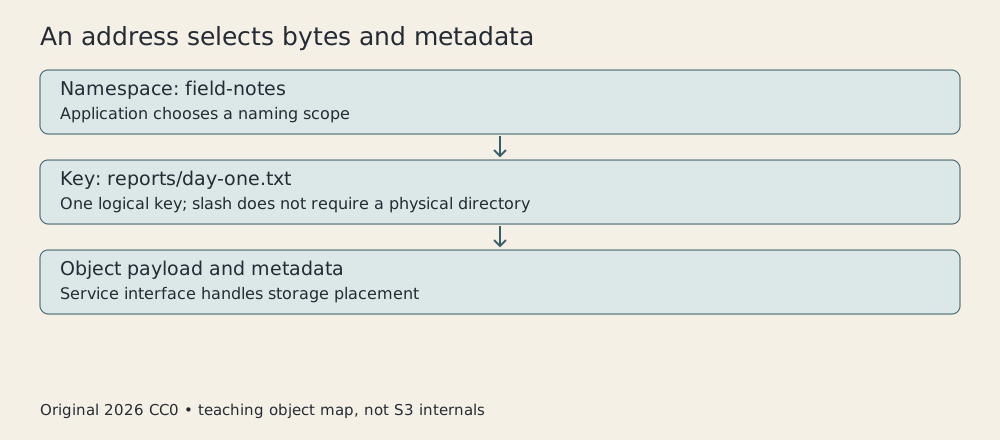
Original CC0 diagram, 2026. Simplified namespace/key model; no exact S3 internal layout asserted.
The simplicity is useful precisely because it leaves out disk placement. The application doesn’t need to know which machine contains the bytes to construct its lookup. It does need the correct logical address and permission to use it.
Object storage changes how edits are expressed
An object interface isn’t automatically the same thing as opening a local file and changing one byte in place. The application should reason about the operations the service actually exposes.
For our model, updating a report means constructing a replacement payload and assigning it to the key. The programmer chooses the whole new value. The dictionary doesn’t expose a disk sector or a mutable file handle.
Consider a ten-MiB invented report that changes once a day. Replacing it ten times supplies 100 MiB of payload across those ten updates in our simplified accounting, even if each logical edit changes only a short sentence.
That arithmetic isn’t an S3 bill or a claim about every API optimization. It shows why access patterns matter. A small logical change can correspond to a larger transferred value when the application’s chosen unit is large.
Split the report into ten one-MiB objects and change only one part each time. Our payload accounting becomes ten MiB for ten updates. But the application now has ten names, needs to remember their order and must define what it means to publish a complete report.
Smaller units can reduce one cost while increasing coordination. There isn’t a universal object size that makes all workloads inexpensive and simple. The appropriate boundary depends on how the data is written, retrieved and interpreted.
A manifest gives several objects one meaning
Suppose the ten-part report is accompanied by a manifest listing its keys in order. A reader obtains the manifest, then retrieves those parts and assembles them.
The manifest is another object with a special application meaning. The store sees a payload. The application sees instructions about which pieces constitute one report.
Now imagine publishing a second edition. Give changed pieces new keys and construct a new manifest. This avoids overwriting pieces that a reader of the first edition still needs, under our model’s assumptions.
It doesn’t eliminate publication ordering. A reader shouldn’t receive a manifest referring to pieces that aren’t available. The application needs to decide when and how its new collection becomes visible.
A successful write of one object isn’t automatically a transaction across every object in the report. Our teaching store supplies no such transaction. The distinction matters whenever several individually valid values have to agree as one application-level result.
The model checks a two-part miniature manifest and reconstructs west wind. Changing the manifest to list the parts in reverse produces windwest instead. The bytes are intact in both cases; the arrangement determines their meaning.
This is why object identity isn’t the whole data model. Relationships, ordering and publication state can belong to the application. A storage interface can preserve objects faithfully while an incorrectly constructed manifest tells the reader the wrong story.
Accepted and visible are different questions
S3’s original era needs a consistency boundary. In December 2020, AWS announced strong consistency for operations including GET, PUT and LIST, explicitly describing the preceding eventual-consistency behavior.2
That later source is used to prevent a modern guarantee from being assigned to 2006. It isn’t treated as an exhaustive description of every earlier operation, region and special case.
To illustrate the general issue, our second teaching model has a current object value and a delayed reader view. Initially both show west. A write changes the current value to north, while the reader view remains west until an explicit propagation step.
A read before that step returns west. A read afterward returns north. The delay is one model step, not a measured S3 interval or a claim about its actual replication architecture.
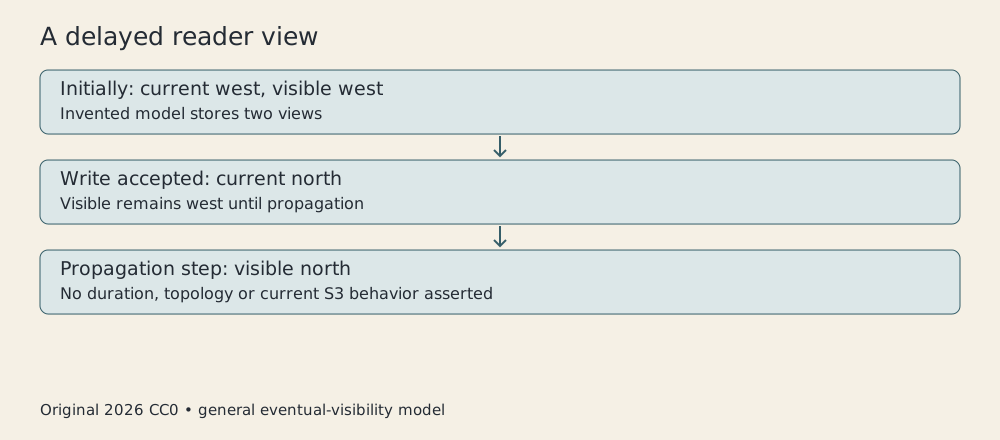
Original CC0 illustration, 2026. Invented eventual-visibility model; no historical delay, topology or present S3 behavior implied.
This makes two questions visible: has the service accepted the value, and what will another observation currently see? An application that assumes they always coincide can behave confusingly when its storage contract allows a gap.
Retries alone don’t explain the gap. Repeating an operation can be useful, but the application still needs to know what observation would establish success and what repeating a write might replace.
The 2020 change simplified important expectations. It doesn’t rewrite the history of applications built before it. Later improvements belong in the account as improvements, rather than being smuggled backward into the original interface.
Access control travels with the service boundary
The launch announcement described private and public objects and rights for specified users. Jeff Barr’s contemporary post also described access-control lists and metadata.13
For our dictionary model, give one object a readers set containing Lee and Sam. The model permits those names and rejects Jo. This demonstrates a policy check without implementing credentials, signatures or S3’s ACL semantics.
A meaningful real system must connect an authenticated caller to the policy. A name supplied by an untrusted request isn’t proof of who made it. The check here verifies only that an invented policy function treats the supplied identities as specified.
Public retrieval can be useful for distributing selected material. It is a different decision from private retention. The application needs to decide which data belongs on each side of that boundary.
The interface doesn’t make that decision automatically correct. A service can faithfully enforce an overly broad policy. Administrative correctness includes selecting the intended policy as well as operating the mechanism that checks it.
Durability and availability have different meanings
The original announcement described reliability and availability as design requirements. Barr’s launch post said data was stored in multiple locations.13 These are source statements about design, rather than an availability test performed for this article.
Durability concerns retaining the data. Availability concerns reaching it when needed. A retained object can be temporarily unreachable, and an accessible interface can return an object the application mistakenly overwrote.
Replication doesn’t understand that an authorized deletion was a mistake. Additional copies can protect against some failures while accurately propagating an unwanted operation. Recoverability needs its own plan.
This is another consequence of the service boundary. The operator takes responsibility for much of the storage machinery, but the application remains responsible for its data lifecycle and for communicating failures to its users.
No historical or current service price is used to recommend a purchase. No uptime figure is presented as measured. The article concerns the 2006 interface and the design consequences visible through original worked models.
Storage becomes something an application requests
S3’s minimal object interface made Internet storage a component that developers could request programmatically. The disk was still there somewhere, but choosing and maintaining it wasn’t the first operation in the application’s upload workflow.
The examples show what remained on the application side: useful keys, appropriate payload boundaries, relationships among objects, publication ordering and access decisions. Moving the disk boundary didn’t abolish those responsibilities.
That combination made the milestone consequential. Storage capacity and operation could be obtained through a comparatively small interface, while the programmer built the meaning around it.
A named object is a modest abstraction. It asks the service to remember these bytes under this address. A large part of subsequent application design follows from deciding what “these bytes” and “this address” should mean.
Sources
Footnotes
-
Amazon, Amazon Web Services Launches, March 14, 2006. Launch functionality and stated design requirements; requirements aren’t measured guarantees. ↩ ↩2 ↩3
-
Jeff Barr, Strong Read-After-Write Consistency, December 1, 2020. Later consistency milestone and description of preceding behavior; not backdated. ↩
-
Jeff Barr, Amazon S3, March 14, 2006. Contemporary objects/keys, metadata, ACLs and multiple-location storage description. ↩ ↩2