C:\2000S\RUBYONRA.TXT
2005
Rails 1.0: The Framework Makes Some Decisions
Rails 1.0 joined database models, request handling and templates through conventions that made an ordinary web application easier to assemble.
A small web application can spend a surprising amount of code saying how its parts relate. This class uses that table. This address selects that operation. This operation passes those values to that template. The relationships are necessary, but writing each one explicitly doesn’t always make the application more understandable.
Rails 1.0 arrived on December 13, 2005. David Heinemeier Hansson’s announcement emphasized consolidation and credited hundreds of contributors, rather than presenting the milestone as a completely new feature collection.1
The framework offered a coordinated way to build common web applications. The programmer could accept established relationships and concentrate more of the code on the application’s own decisions.
That bargain had a condition: conventions have to be understood. An omitted declaration doesn’t mean an omitted rule. It means the rule comes from the framework’s agreement about how things fit together.
A name can carry a mapping
The Active Record README at the preserved 1.0 tag shows a class being associated automatically with a plural table name. It also describes attributes derived from columns, associations and validation.2
For an original example, invent a lending catalogue. A Book represents a row in books. A Loan represents a row in loans. Each loan carries a book_id relating it to the relevant book.
This is a small regular naming example, not a complete account of English inflection. A teaching function that adds s to every word would fail on many names. Our check uses an explicit mapping for these two invented classes rather than pretending to implement Rails’ inflector.
Give books two rows:
| id | title |
|---|---|
| 1 | Harbour Signals |
| 2 | Field Repairs |
And give loans three rows: two referring to book 1, one to book 2. Asking for the title belonging to a loan means following its book_id, not guessing from the loan’s order in the table.
The database relationship remains real even if the framework saves the programmer from repeating the obvious mapping. A convention translates a name into an expectation; the data still has to satisfy that expectation.
Now introduce a legacy table named catalogue_entries. The default Book mapping would point somewhere else. An explicit exception can be appropriate, but the developer has to recognize that an exception is required.
Conventions make a regular application smaller to describe. They don’t make an irregular external system regular by wishing at it. The value is strongest when the application and its environment can accept the same agreements.
Follow one request through the parts
Suppose a visitor asks to view book 1. Our conceptual route identifies a book-display operation and supplies the identifier. The controller obtains the relevant record and chooses a view. The view renders a title and related information.
Action Pack’s 1.0 README describes this separation between controller logic and view rendering, with actions as controller methods.3 We are explaining that period arrangement, rather than claiming the following outline is an exact generated Rails 1.0 application.
request for book 1
    → select display operation
    → find book whose id is 1
    → render Harbour Signals
The controller isn’t merely a tunnel for database contents. It can decide what to do if the identifier doesn’t exist, whether the visitor may see the record, and which response is appropriate.
The view isn’t the right place to silently decide who owns the record. It should receive the information and decisions needed to present the response clearly. Putting every responsibility into a template makes the application harder to reason about even if the first screen appears quickly.
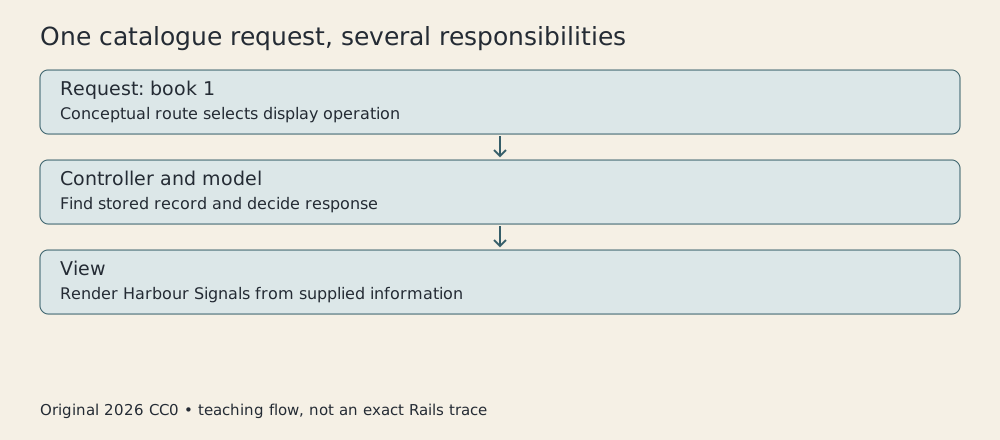
Original CC0 diagram, 2026. Invented catalogue request; not a Rails 1.0 trace or generated application screen.
Our executed demonstration uses a modern SQLite in-memory database and a small Python renderer. It looks up book 1 and confirms the displayed title. It separately checks that the same query for book 99 returns no row.
This tests the example’s data and query result. It does not run Ruby, Rails’ routing code or an old template engine. The boundary is explicit because substituting a modern working model for an untested period runtime would otherwise make the article seem more verified than it is.
Relationships answer a different question from lists
Ask how many loans belong to each book. The invented database joins books.id to loans.book_id, groups by book and obtains two for Harbour Signals and one for Field Repairs.
This doesn’t count every book as loaned merely because a loan table exists. Nor does it assume that the first loan belongs to the first book. The stored key is the relationship.
A framework’s association declaration can give that relationship an accessible vocabulary in application code. The programmer can ask about a book’s loans rather than constructing the same lookup procedure repeatedly.
The convenience doesn’t eliminate the need to understand what gets fetched. Asking for related records can involve database work. Repeating it for a list of many objects can produce more queries than the visible code suggests.
For a general teaching calculation, suppose a page shows ten books. One query retrieves the books, and a separate lookup retrieves loans for each. That makes eleven queries in the model. A suitable combined retrieval might reduce the number of round trips, though the exact SQL and data volume depend on the intended result.
These are invented query counts, not a Rails 1.0 performance benchmark. The point is that short application code and inexpensive execution are different properties. A framework can hide the repeated syntax without removing the repeated operation.
Validation belongs before a successful save
The period Active Record README includes validation examples.2 For our catalogue, a new book needs a nonblank title. That is an application rule, rather than a fact supplied by the framework’s name mapping.
Our model attempts to save a title consisting of three spaces. After trimming it for the presence check, the value is empty. The save is rejected, and the number of book rows remains two.
The next attempt uses Night Ferries. It passes the model’s rule and becomes the third book. The check verifies both the rejection and the successful insertion.
A form should then explain the rejected value and preserve useful input so the person can correct it. The existence of a validation rule is only half of the experience. A server’s refusal without a comprehensible response still leaves the user doing detective work.
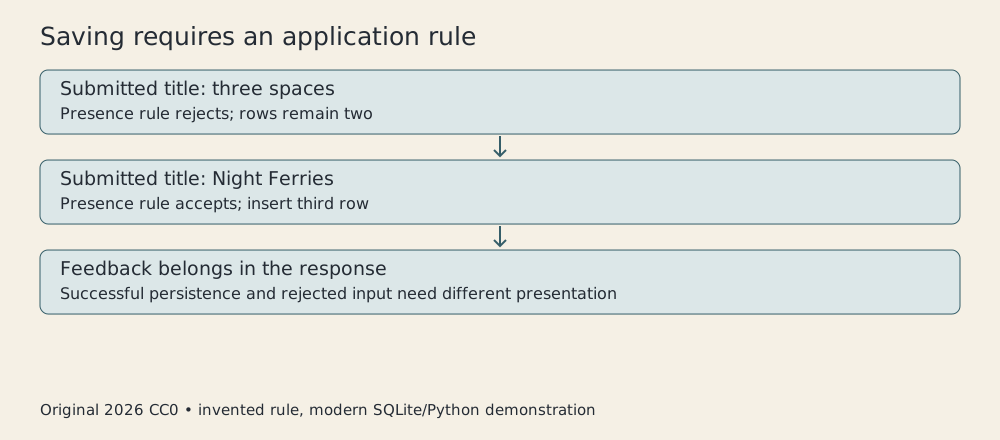
Original CC0 illustration, 2026. Invented title rule and modern demonstration; not recovered Rails validation internals.
Presence isn’t every kind of validity. Night Ferries may be a nonempty string and still refer to the wrong book. A rule needs to express a requirement the application can actually evaluate, without claiming to certify facts outside its knowledge.
Likewise, an application-level check isn’t a substitute for every database constraint. Concurrent requests can encounter conditions a single isolated form never sees. A dependable system needs to understand which rules must hold at the storage boundary as well as which checks improve the user’s feedback.
No concurrent Rails experiment was performed here. That distinction is a general design implication, not an assertion that this miniature catalogue demonstrates all possible races.
A framework also supplies a vocabulary for change
Once the parts have recognizable roles, another developer can approach the project with a useful starting map. A controller suggests request decisions. A model suggests stored domain information and related behavior. A view suggests presentation.
The roles don’t dictate where every future feature belongs. They make disagreements discussable. “This rendering code is deciding a lending rule” is a more precise criticism when the application has agreed names for those responsibilities.
That can matter more over time than the number of lines saved in the first demonstration. Features accumulate, and the same project needs new people to find where decisions live.
A framework is also a dependency that changes. Its conventions, interfaces and supported environments need maintenance. A release milestone doesn’t guarantee that an application can ignore all subsequent compatibility work.
The Rails announcement acknowledged remaining tickets and identified 1.0 as a stabilization point.1 It is period evidence for a project reaching an important threshold while remaining unfinished software, which is usually what important thresholds mean in practice.
Fast beginnings don’t prove finished products
The 1.0 Action Pack README includes scaffolding and helpers, alongside testing support.3 Such facilities can establish a useful starting structure. They cannot decide the application’s complete permissions, domain rules or presentation requirements.
A generated or conventional listing page can make a prototype tangible. That lets the developer inspect real interactions sooner. It also makes it tempting to treat “the page works” as “the application is complete.”
The catalogue example deliberately avoids that claim. It checks a lookup, a relationship count and a simple save rule. It has no authentication, production server, complete lending policy or deployed website.
The user has not been offered a historical setup command copied into a contemporary environment. No framework was installed and no service was provisioned. The period source readings establish the features discussed; the modern check makes the invented mechanism inspectable.
Keep one oh in its own decade
Later Rails acquired features and changed APIs. Modern routing syntax, current security defaults and present deployment practices don’t belong automatically to December 2005. The preserved tag gives this article a firmer boundary than a current tutorial would.
Rails 1.0’s consequential proposition was coordination. Common naming connected application objects to stored records. Request handling and rendering had established roles. Validation could sit alongside the domain object rather than being rediscovered in each form.
The price was learning what the framework would infer. A convention makes a declaration shorter by moving part of it into shared knowledge. When that knowledge is wrong for the application, the developer needs an explicit decision.
That is a practical kind of opinionated software. It saves work by answering recurring questions in advance. The programmer’s job becomes recognizing which answers fit and knowing when the catalogue, the request or the rule needs something more specific.
Sources
Footnotes
-
David, Rails project, Rails 1.0: Party like it’s one oh oh!, December 13, 2005. Release, stabilization and collective contributor credit. ↩ ↩2
-
Rails project, Active Record README at v1.0.0. Period mapping, associations and validation sections actually read. ↩ ↩2
-
Rails project, Action Pack README at v1.0.0. Controller/view arrangement, helpers, scaffolding and testing sections actually read; not current Rails documentation. ↩ ↩2