C:\2010S\MINECRAF.TXT
2011
Minecraft 1.0: The World Is Also the Material
Minecraft's 2011 full release gave an open-ended block world a formal milestone without taking its possibilities away from the player.
A hill in a game usually tells you where you can walk. In Minecraft, it can also tell you where to get the material for something you would rather have than a hill.
That change gives the landscape two jobs. It is a place to explore and a collection of objects to alter. A shelter can be a response to the environment and a modification of it, made through the same basic interaction that removes an inconvenient block from a path.
Minecraft’s full PC version arrived on November 18, 2011, during Minecon. The publisher’s later chronology ties that release to the Ender Dragon encounter and an ending, while distinguishing it from the game’s earlier public development.1
Version 1.0 matters as a milestone in an already active project. Markus Persson’s January 2011 interview describes a game with a substantial audience, a growing team at Mojang, and a full version still ahead. It also describes inspirations including Dwarf Fortress, RollerCoaster Tycoon, and Dungeon Keeper.2
The release didn’t make Minecraft interesting by closing it. It gave a recognizable completion point to a system whose central attraction was the player’s ability to keep making decisions.
Simplicity provides a common grammar
A world made of blocks has a useful consistency. Removing and placing material happen in discrete units. Shapes can be counted, rearranged, and reconstructed. A player doesn’t need a separate modeling tool to begin changing the environment.
Persson’s period interview discusses experiments with smoother character shapes and randomized polygon corners that were discarded because they distracted from the game’s feeling.2 The blocky appearance was a design choice, rather than merely evidence that nobody had heard of curves.
The grid supplies a shared grammar for planning. You can describe a wall as seven blocks long and three blocks high. That description is enough to begin construction, even if the result’s appeal depends on many choices beyond arithmetic.
It also makes a player’s marks persist as spatial decisions. A building is an arrangement of world material, rather than just a decorative image unlocked by a menu. The world can contain evidence of what the player has done.
This is one reason the relationship between exploration and construction is so productive. Exploring finds places and resources. Building changes the places and consumes or arranges the resources. The actions feed one another without requiring a completely separate mode of interaction at every step.
Plan a room before placing it
Here is an original construction exercise, deliberately limited to full cube geometry. Design a small rectangular room with an outside footprint of seven by five blocks. Give it a floor, walls three blocks high above the floor, and a roof above those walls.
The floor takes:
Count the perimeter without counting its corners twice. The two long edges contribute fourteen blocks. The remaining portions of the short edges contribute two times three, or six. One perimeter layer therefore takes twenty blocks.
Three wall layers take sixty. A full roof takes another thirty-five. Before an opening, the material count is:
Leave a two-block-high entrance in the middle of one long wall. Omitting those two wall blocks brings the model to 128 cubes.
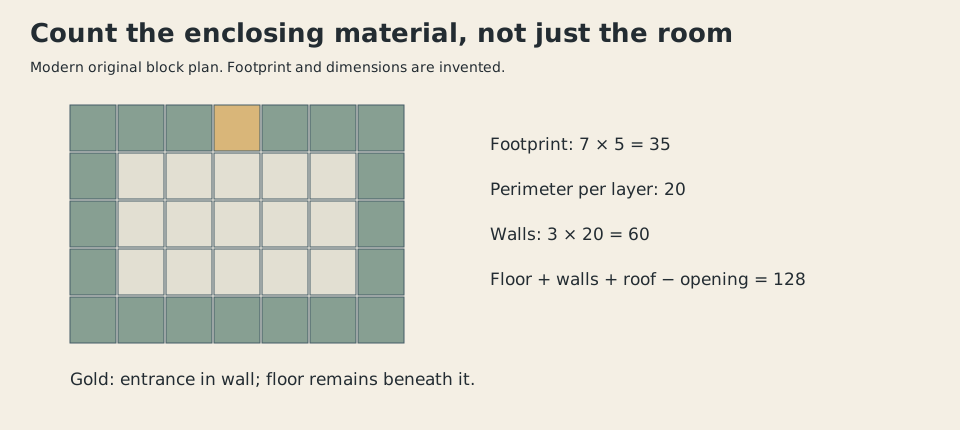
Original construction diagram, 2026. Invented seven-by-five footprint, three wall layers, and an entrance. No game textures, historical screenshot, or period build are reproduced.
The room’s interior footprint is five by three, or fifteen blocks. Its usable interior height is three blocks under the roof. The outside volume looks more generous because it includes the material enclosing the space.
This is elementary arithmetic, but it explains a real kind of player reasoning: a desired room implies a perimeter, that perimeter implies materials, and those materials imply more interaction with the world.
Our exercise ignores doors, windows, lighting, block-specific behavior, and every survival rule. It isn’t a guaranteed safe Minecraft shelter or a crafting recipe. It is a checked planning model for the geometric part of construction.
The restrictions are helpful. They keep the interesting relationship visible: a building plan becomes a finite set of placements. The player can compare a design with its cost before deciding whether the roof needs to be larger for reasons of architectural vanity.
Inside faces still exist in the data problem
The same arrangement raises a rendering question. One isolated cube has six faces. Two cubes side by side have twelve faces in a naive count, but their shared interface contains two faces that cannot be seen from outside the solid pair. Drawing only exposed faces leaves ten.
For an original toy renderer, represent occupied cells as integer-coordinate triples. For each occupied cell, inspect its six immediate neighbors. If a neighbor is empty, the corresponding face belongs to the exposed surface. If a neighbor is occupied, omit that shared face.
neighbors = [(1,0,0), (-1,0,0), (0,1,0),
             (0,-1,0), (0,0,1), (0,0,-1)]

def exposed_faces(cells):
    return sum((x+dx, y+dy, z+dz) not in cells
               for x, y, z in cells
               for dx, dy, dz in neighbors)
This teaching code is original. It explains one general voxel-surface mechanism; it isn’t extracted from Minecraft 1.0 or asserted to reproduce its renderer.
A three-by-three-by-three solid cube contains twenty-seven unit cubes. A naive six-faces-per-cube representation offers 162 faces. Its exposed outside surface contains only six sides of nine faces each, or fifty-four.
Removing the central cube leaves twenty-six occupied cells. The outside remains fifty-four faces, but six more now face the enclosed cavity. Our neighbor test reports sixty exposed-to-empty-cell faces.
That doesn’t mean a camera outside the solid can see all sixty. Empty-neighbor testing removes shared solid faces; it doesn’t solve visibility through walls. Further rendering decisions are needed to avoid drawing geometry hidden from a particular viewpoint.
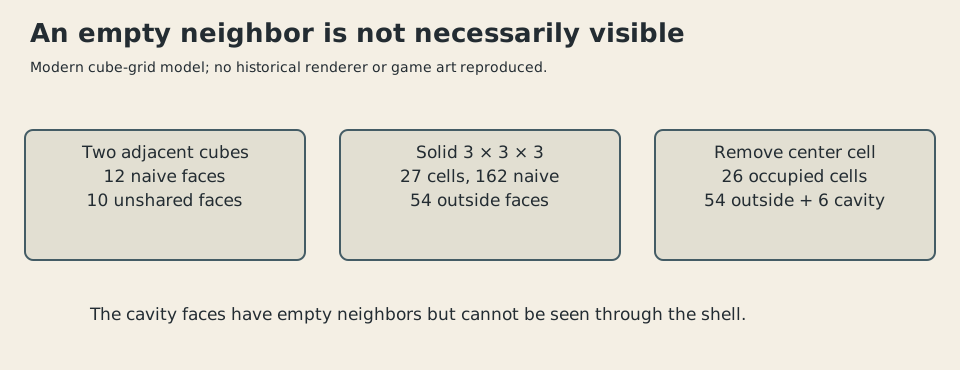
Original explanatory diagram, 2026. Generic cube-grid face counts, checked in Python. It illustrates a rendering idea rather than documenting Minecraft’s exact implementation.
This is a satisfying piece of the software argument. A block world can be conceptually simple while still creating serious work for storage, surface generation, and rendering. The player edits one cell. The software must keep the surrounding representation coherent.
Crafting turns arrangement into a rule
Construction places material in the world. Crafting uses an arrangement of ingredients to obtain something else. That gives the same discrete vocabulary another kind of meaning.
The publisher’s crafting-table history dates crafting and the table to January 2010, before 1.0. It identifies the familiar four-plank square recipe and notes that the in-game recipe book arrived much later, in version 1.12.3
Those boundaries matter. A modern tutorial can make a 2011 system look more self-explanatory than it was. A later interface that displays recipes shouldn’t silently appear in a first-release account.
For a general rule-matching model, imagine a two-by-two ingredient array filled with four planks. Matching that array to a recipe produces a crafting table and consumes the required ingredients. A different pattern can fail to match even if the ingredient total is unchanged.
That model explains why a recipe can encode placement as well as inventory quantity. It doesn’t implement Minecraft’s historical matching rules, alternate materials, or shapeless recipes. The four-plank example comes from a publisher retrospective; no historical client was run here.
The effect on play is a sequence of prerequisites. The player needs material, a known recipe, and the appropriate crafting opportunity. Learning one useful transformation makes another possible.
There is a productive tension between experimentation and opacity. A rule system supports discovery, but an undiscovered essential rule can also leave a newcomer stuck. The game doesn’t become more interesting merely because a player can’t guess the right square.
Full release didn’t finish the explanation problem
In a near-period interview published in February 2012, Jens Bergensten discusses taking over lead development, the small team’s priorities, and the difficulty new players faced without somebody explaining the game. He also distinguishes the PC, Pocket, and console development work.4
That is valuable primary testimony because it doesn’t confuse popularity with the absence of usability problems. An enthusiastic community can teach a system effectively while the system itself remains difficult to begin.
It also reminds us that Minecraft’s name covers implementations with different histories. This article concerns the full PC release that later came to be called Java Edition. Features of modern Bedrock editions, cross-platform arrangements, and later updates aren’t automatically features of November 2011.
The stronghold history gives a narrower example of release-specific expansion: strongholds were present in the September 2011 beta update, while their End portal rooms arrived with 1.0.5 The release added a destination to an existing world, rather than creating every part of that world anew.
An ending without an exhausted world
An ending can provide a goal for players who want one. An editable world can continue to support goals the developer never enumerated. Minecraft 1.0 held both possibilities in the same product.
Our tiny room exercise explains one side of that appeal. Its goal is chosen by the player; its constraints arise from a common material model. The software doesn’t need a special mission called “build a seven-by-five room” for the room to be meaningful.
The rendering exercise explains another side. Supporting that freedom requires the program to maintain a changing geometric world. The apparent simplicity of cubes doesn’t make all consequences simple.
I find that combination more interesting than an argument about whether Minecraft is a game or a toy. Its rules make construction consequential, and its construction gives the player somewhere to express intentions beyond the supplied objectives.
Version 1.0 offered a formal milestone and a path toward an ending. The landscape remained material. A player could reach the dragon, then decide that the more urgent unfinished business was still the roof.
Sources
Footnotes
-
Joe Skrebels, Xbox Wire, “The Most Important Moments in Minecraft’s First 15 Years”, May 17, 2024, 2011 section. Publisher retrospective for November 18 full release and Ender Dragon milestone; ambiguous early player totals and 2009 exact-day claims aren’t used. ↩
-
Mike Rose, “Road To The IGF: Minecraft’s Markus Persson”, January 25, 2011. Creator interview on inspiration, tools, team, upcoming release, and discarded visual experiments. Its early prototype chronology isn’t used to settle an exact first-release date. ↩ ↩2
-
Duncan Geere, Minecraft, “Block of the Week: Crafting Table”, February 2, 2018. Later publisher history of January 2010 crafting and version 1.12 recipe-book boundary. Recipe isn’t represented as newly invented in 1.0. ↩
-
Christian Nutt, “Talking the Future of Minecraft”, February 6, 2012. Developer interview, including onboarding and separate edition development. Later than launch and labeled accordingly. ↩
-
Duncan Geere, Minecraft, “Stronghold”, later publisher feature history. Read the explicit September beta/November 1.0 distinction; modern stronghold descriptions aren’t imported wholesale into 2011. ↩