C:\2010S\STEAMWOR.TXT
2011
Steam Workshop: A Hat Needs a Supply Chain
The 2011 Team Fortress 2 Workshop made community-made items easier to submit, discuss, and consider for a living game.
A handsome object in a modeling program isn’t yet a useful object in a game. It may be too expensive to draw, attached to the wrong place, impossible to recognize at a distance, or simply absent from the files the game knows how to load.
Then there is the human part of the pipeline. Somebody must find the submission, understand it, judge it, and arrange its arrival in the product. An email inbox can do some of that work. Eventually the inbox becomes an archaeological site with attachments.
Valve launched Steam Workshop for Team Fortress 2 on October 13, 2011. The announcement described a hub for uploading community-made items, tracking status, receiving Valve feedback, and letting the community browse, comment, and rate submissions.1
That specific milestone matters. It wasn’t yet a universal system in which every supported game handled every community file the same way. The early Workshop supplied a better front door to an existing item-making relationship. Its consequence was to make the path from player creativity toward a maintained game more visible and organized.
The hat was still a hat. Getting it into the right hands had become software.
A living game creates a different production problem
Team Fortress 2 had already developed an item economy before Workshop’s launch. The October announcement marked the Mann Co. Store’s first anniversary and reported more than $2 million earned by item creators over the preceding year. That is Valve’s contemporary report, not an independently audited figure.1
It establishes an important sequence: community-created items and compensation didn’t begin on the day Workshop appeared. Workshop improved the submission and discussion system around them.
Joe Ludwig’s 2012 GDC presentation places the game in successive eras of updates, items, the in-game store, and free-to-play. His account treats community participation as an ongoing part of development, with attention to players’ concerns about paid advantages and the value of existing items.2
A maintained multiplayer game has reasons to be selective. An item affects more than its creator’s portfolio. It joins an established visual language and may interact with characters, animations, performance budgets, and an economy that players already understand.
This makes “accept user content” a deceptively short specification. Accepting a file into a website and accepting an object into a game release are different decisions. The former makes a proposal available. The latter makes the developer responsible for how it behaves.
Work backward from the running game
Two days before the launch, Valve artist Bay Raitt published a making-of account for a skull hat. It wasn’t presented as a community submission, but it exposed relevant production work: shaping a sculpt, creating a lower-polygon mesh, arranging texture coordinates, generating a normal map, attaching the result to a hat joint, and checking it on characters in the game.3
The sequence helps explain what a contribution system must carry. A preview image communicates an idea; the geometry, textures, and attachment information make it testable.
In an original teaching example, imagine a community-made signal cap. Its silhouette has three components: a rounded crown, a narrow brim, and a small raised badge. We aren’t reproducing a TF2 item or specifying Valve’s submission format. We are asking what must survive as the cap travels from an artist’s tool into a game.
At least four relationships need to remain coherent:
- Geometry describes the visible shape.
- Texture coordinates connect surfaces to image detail.
- Attachment places the cap on a moving character.
- Preview and description tell reviewers what the package intends to do.
A missing relationship can produce a technically readable file that is still wrong. The cap might have all its textures but fit only one character’s head. Its preview might show a detail that the supplied geometry never contains.
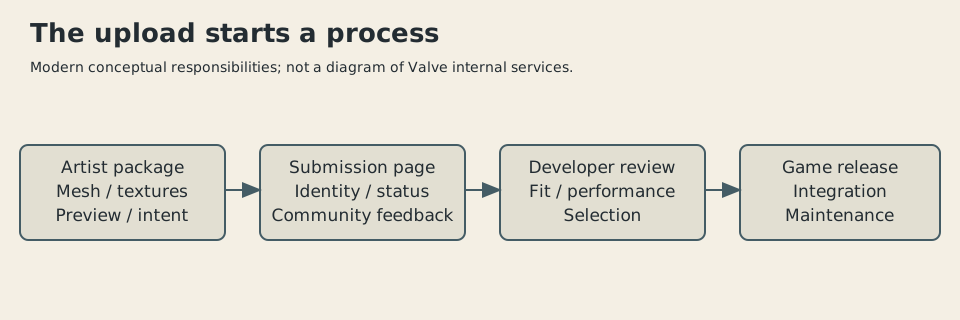
Original illustration, 2026. General submission and release responsibilities, informed by the launch and artist account. Not a reconstruction of Valve’s internal approval software.
I like the discipline of testing the object in the actual environment early. A polished preview can postpone the moment when an awkward fit becomes undeniable. It is usually cheaper to discover that the hat intersects someone’s face before giving it beautiful shading.
Detail has more than one budget
Raitt’s account explains replacing a detailed sculpt with a cheaper mesh and using a normal map for surface detail. His stated targets were under 1,000 polygons for hats and under 6,500 for weapons. These are the artist’s 2011 working targets, not asserted here as universal upload limits.3
A polygon count alone doesn’t predict rendering time. Materials, textures, visibility, animation, and the surrounding scene also matter. But geometry is one resource the item author can reason about before multiplying it across a busy game.
Give our invented cap 800 triangular faces in its full-detail mesh. Suppose 24 visible players each wear one. The cap meshes alone then contribute:
Now invent a distance policy: eight nearby caps use 800 triangles, while sixteen farther caps use a simplified 200-triangle mesh. The contribution becomes:
That halves this particular triangle total. It doesn’t establish a doubling of frame rate. The rest of the frame’s work is unchanged, and the model ignores the cost of choosing detail levels and rendering the objects.
Nor is it evidence that Workshop’s initial uploader required this exact pair of meshes. This is an original resource-budget model. It explains why a contribution that looks cheap in isolation can matter when many instances appear together.
A normal map changes a different part of the bargain. It can supply information used for shading surface orientation without modeling every small bump as geometry. It cannot freely replace the silhouette of a large protrusion. A painted bump at the edge of the cap won’t become a real brim merely because the lighting is convincing.
The author therefore chooses which detail belongs in shape and which can be expressed through shading. That is a production decision with a visible consequence, not a checkbox labeled “make optimized.”
Feedback is information, not a release command
The launch hub made community reaction visible around submissions. A shared page can collect interest and criticism where the item and its author are identifiable. That is more useful than scattering feedback among unrelated forum conversations.1
It doesn’t follow that the highest-rated proposal should automatically ship. Rating and technical review answer different questions.
Consider three fictional caps. Alpha attracts 900 favorable reactions but doesn’t fit two characters. Beta attracts 450 and passes the developer’s checks. Gamma attracts 700 but uses artwork its submitter cannot account for. These numbers are invented; they aren’t historical Workshop submissions.
Popularity suggests which ideas people want to see. It doesn’t resolve fit, performance, provenance, or the game’s editorial direction. A contribution system needs ways to preserve both kinds of information without making one masquerade as the other.
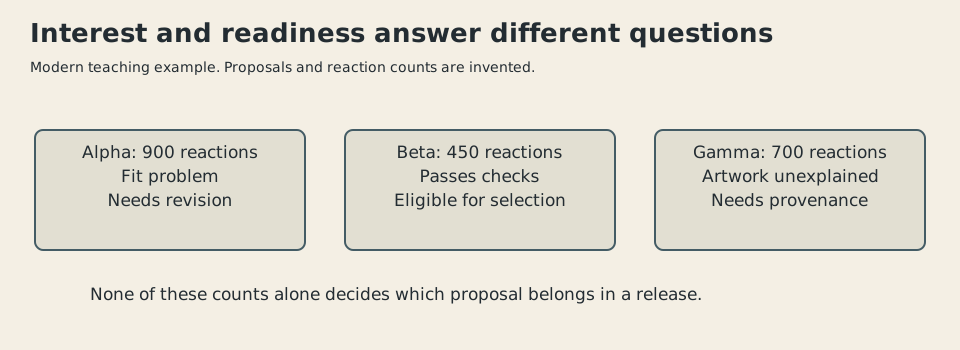
Original explanatory illustration, 2026. Fictional proposals and qualitative readiness labels; no historical Workshop ranking algorithm is implied.
The same separation protects creators from a different misunderstanding. Public attention is meaningful, but it isn’t a promise of acceptance or income. The system can expose status and discussion while leaving selection to the developer.
There is also a maintenance cost after selection. A changed character model or rendering path may require an accepted item to be retested. A distribution platform can carry the file; responsibility for compatibility must still belong somewhere.
The route broadens without becoming identical
On December 1, 2011, Valve published Bethesda’s announcement that Skyrim would use Workshop for submitting, browsing, rating, and downloading mods. This was a subsequent application of the platform, described as upcoming in that announcement.4
It should not be read backward into October’s TF2 item hub. A mod-distribution arrangement and a curated item-contribution arrangement can share pages and community functions while making different promises about what reaches the game.
An optional user-installed modification can change one player’s environment or a selected group of players. An item integrated into an official multiplayer product participates in a common maintained release. Those contexts demand different compatibility and selection policies.
The platform’s importance is easier to see when those differences remain visible. Workshop supplied reusable coordination machinery around user-made content. Games could decide how that machinery related to their own tools and distribution model.
It also brought dependency on a platform. A central hub can make discovery easier and give creators a common audience, while tying visibility and distribution to that hub’s rules. That is a structural consequence, rather than a claim that every creator benefited equally.
A better boundary between making and adopting
Steam Workshop’s early achievement was to make a contribution recognizable as a process: a package with an author, a discussion, and a status on its way toward a decision. It joined technical artifacts to the people who might adopt them.
That is more consequential than the modest noun “upload” suggests. Uploading moves bytes. A contribution pipeline moves a proposal through several different judgments, and preserves enough context for the judgments to be useful.
The 2011 TF2 case is especially clear because the creator economy preceded the new hub. Workshop didn’t conjure creativity or commerce out of empty space. It supplied a more organized relationship between them and an already maintained game.
The object on the character’s head was the visible result. Around it sat geometry budgets, fit checks, community response, selection, and distribution. For a small hat, it had acquired a fairly substantial administrative life.
Sources
Footnotes
-
TF2 Team, “Surprise Manniversary Update and Sale”, October 13, 2011. Workshop launch functions; earlier Mann Co. Store and reported creator earnings. No payment percentage inferred. ↩ ↩2 ↩3
-
Joe Ludwig, Valve, Team Fortress 2: From The Orange Box to Free to Play in “Just” Four Years!, GDC 2012. Participant presentation; extracted text inspected for development eras and economy lessons. Graphs aren’t reproduced or used for quantitative estimates. ↩
-
Bay Raitt, “Making of a Skull Hat”, October 11, 2011. Primary artist account of mesh, texture, normal-map, attachment, and in-game checks; targets are explicitly working guidance. ↩ ↩2
-
Valve/Bethesda, “Steam Workshop Coming for Skyrim”, December 1, 2011. Later announced mod-distribution application, distinct from the October hub. ↩