C:\2010S\PROTON.TXT
2018
Proton: Keep the Game, Translate Its Assumptions
Proton's 2018 Steam Play beta packaged Windows compatibility for Linux gaming, making translation and its remaining limits part of a routine launch workflow.
A game rarely asks an operating system for just one thing. It opens files, creates windows, receives input, sends sound and graphics work somewhere, and waits for other work to finish. It may also bring a launcher with its own opinions about the machine.
Getting the main executable to start is therefore an encouraging first result. It is a poor definition of compatibility.
Proton made an existing body of Windows compatibility work easier to use from Steam on Linux. Its practical contribution included packaging: a game could be installed and launched through a familiar client while the machinery underneath worked to satisfy assumptions originally made about another operating system.
That is an unusually appealing bargain for a back catalog. The game can remain the game, including its existing executable, while the environment takes on the translation work.
A new Steam Play beta, rather than the first Steam Play
Valve’s August 21, 2018 Linux beta introduced Proton, combining modified Wine with other libraries. Steam Play itself dated to 2010.1
Valve and CodeWeavers had worked together since 2016. DXVK translated Direct3D 11 to Vulkan; vkd3d handled Direct3D 12. Steamworks and OpenVR bridges accompanied them.
The initial tested list was limited; users could try other titles. Inclusion did not establish Linux store support. DRM and anti-cheat remained obstacles.
Vulkan-based Direct3D 9 and experimental fsync arrived in the archive’s July 30, 2019 Proton 4.11 entry, not at launch.
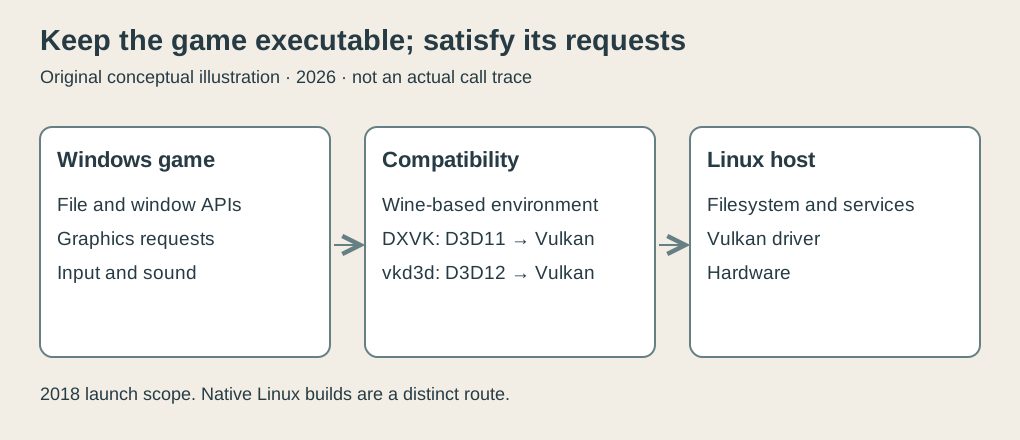
Original explanatory diagram, 2026. A schematic division of responsibilities for a Windows game on Linux; not a recorded Proton call trace or exhaustive component map.
A request carries expectations
A compatibility boundary has to preserve meaning, not merely exchange similar-looking words. Consider a game opening a texture file.
It may supply a path string, access flags and a desired sharing mode. It expects either a usable handle or an error it knows how to interpret. A replacement that returns the right bytes in one easy case has demonstrated something useful, but not the whole contract.
Even the path string can encode assumptions. Microsoft’s file naming documentation identifies backslashes as path separators and cautions Windows developers against assuming case sensitivity.2 A host environment with case-sensitive lookup can distinguish names that an application ordinarily treats as equivalent.
To see the issue without claiming to reproduce Wine’s implementation, build an invented adapter for a tiny asset directory. We deliberately restrict it to ASCII relative paths. There are no drive letters, network shares, parent-directory segments or Unicode names in this exercise.
The available assets are:
textures/hud.dds
audio/click.wav
The invented game requests:
TEXTURES\HUD.DDS
Audio\Click.wav
An exact string lookup against the two stored names fails. The separators and letter case differ. The bytes are present, but the naive adapter cannot find them.
This is the kind of problem that a favorable impression of the graphics can conceal. A missing texture may originate in a mundane file operation long before any shader receives it.
A small adapter, with explicit limits
Our teaching adapter defines a lookup key by replacing backslashes with slashes and converting ASCII letters to lowercase. It builds an index from those keys to actual stored names.
The first request becomes textures/hud.dds. The index points to the stored asset with that name. The second becomes audio/click.wav and resolves similarly.
| Request | Model lookup key | Result |
|---|---|---|
TEXTURES\HUD.DDS | textures/hud.dds | HUD asset |
Audio\Click.wav | audio/click.wav | Click sound |
textures\missing.dds | textures/missing.dds | Missing |
The output of the successful operation should preserve the asset’s contents. Translation changes how the request is interpreted, not which texture the game intended to load.
The missing case is equally important. A compatibility layer should not conjure an arbitrary existing file merely because the requested one is absent. Reporting failure is part of meaningful behavior.
Our original checker confirms both successful lookups and the missing result. It executes in modern Python; it is not Proton code, a general filesystem implementation or a historical game test.
The exercise explains one contract mismatch. It does not establish that real Wine implements path handling with this exact two-step index, or that lowercase conversion alone implements Windows naming. Those would be substantially larger claims.
Two valid host names can be one ambiguous guest name
Now put two assets in the invented host directory:
textures/HUD.dds
textures/hud.dds
A case-sensitive host can keep these as distinct names. Our normalization maps both to the same key. If the index silently accepts whichever was inserted last, the game gets one asset for a reason unrelated to its request.
The model therefore rejects this ambiguous directory when building the index. That is our explicit teaching policy, not a claim about Proton’s real collision behavior.
The point is that a seemingly easy translation can be many-to-one. Once different source names collapse into one interpreted name, the adapter needs a policy. It cannot recover missing information by changing punctuation more enthusiastically.
This collision test makes the example useful beyond the successful demonstration. A compatibility layer has to specify what happens at the edge of its mapping, particularly where two environments organize the same resource differently.
Suppose the invented game retries a missing asset with a fallback name. The first lookup must report failure clearly enough for that retry to occur. Returning an unrelated texture could suppress the fallback and move the symptom elsewhere. The visible picture and the control flow both depend on the result.
The same general problem appears with error codes, object lifetimes, locking rules and timeouts. Names may have counterparts while behavior does not line up perfectly. Each such mismatch can be small on its own and consequential to the application.
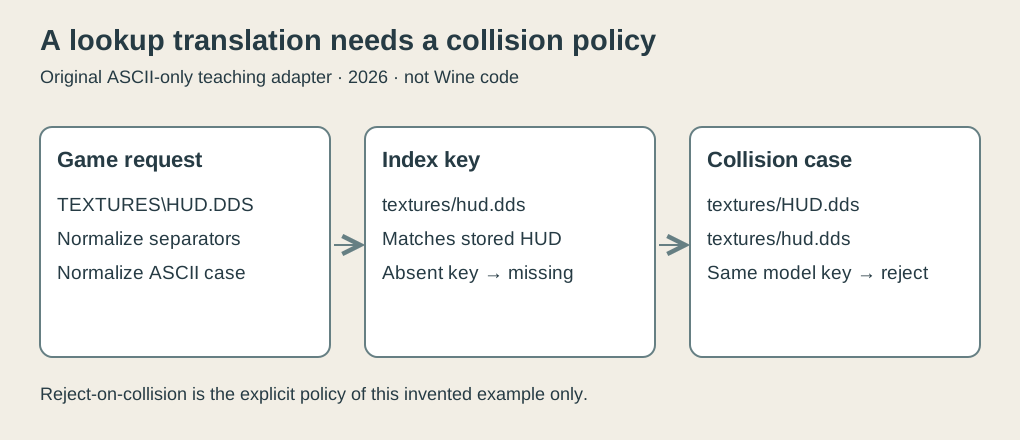
Original explanatory diagram, 2026. Invented ASCII-only lookup keys show successful normalization and a collision. The reject-on-collision policy belongs to this model, not an asserted Wine implementation.
Graphics translation is another contract
A graphics API describes much more than “draw this triangle.” An application establishes resources and pipeline state, submits work, and depends on the resulting images and synchronization behavior.
The launch’s Direct3D-to-Vulkan components supplied a route between API families. That should not be imagined as a universal dictionary in which every source call replaces exactly one destination call. The useful unit is the behavior the game expects, which may require managing state and resources across several operations.
An invented rendering sequence makes the distinction clear. The game loads texture data, creates a texture resource, selects it for a draw and presents the resulting frame. The implementation must ensure that the draw uses the intended resource contents at the appropriate time.
If presentation occurs before the needed work completes, the mere existence of translated draw calls won’t establish correctness. If resource contents are stale, the scene can be drawn with the wrong data. If a conversion is repeatedly redone when it could be reused, the picture might be right while performance is poor.
These are general engineering consequences of the example, not a measured DXVK implementation trace. They explain why correctness, synchronization and performance deserve separate questions when assessing compatibility.
A good screenshot establishes one rendered moment. A usable game has many moments, input events, scene transitions, saves and exits. Tests need to cover enough of that behavior to support the claim being made.
Packaging made the work reachable
Before a player reaches any of these details, the environment must launch the right program with the right components. A technically impressive compatibility tool is less useful if using it requires every player to reconstruct the application’s dependencies by hand.
A familiar entry point changes where a player encounters the engineering problem. Instead of treating each missing dependency as a separate setup project, the player can ask whether a particular title works through the supplied environment. That shifts the practical question toward behavior, while leaving the underlying contracts just as demanding.
Packaging doesn’t eliminate variability. A title may rely on one API subset, a particular driver behavior, extra middleware or an external service. Two games built for Windows can therefore produce very different results through the same compatibility distribution.
Nor does a native Linux version become the same thing as the Windows executable running through Proton. Both may be practical ways to play, but they place different responsibilities on the game and its environment.
For a native port, developers can adapt the application to the target platform. With compatibility, the environment carries more of the burden of preserving the original platform contract. These are useful alternatives whose relative appeal depends on the software and the available work.
A boundary that could improve over time
A useful compatibility claim needs a scope: which application, which environment, and which operations were exercised. “It works” is convenient shorthand between players. For an engineering record, a successful menu, a completed level and a working saved game are separate observations that can support different conclusions.
A compatibility distribution can improve a game’s prospects without requiring a new build of the game itself. Correct a translated behavior, fix a component interaction or improve a driver path, and an existing binary may benefit. That makes the accumulated back catalog an interesting engineering target.
It also creates a continuing testing obligation. An improvement for one behavior can affect another, and a successful launch says little about a later scene or service. Compatibility is a body of evidence built across actual applications.
Proton’s appeal came from keeping that difficult work mostly behind an ordinary action in the client. The player asked to launch a game. Underneath, several pieces of software negotiated what the game assumed that request meant.
Footnotes
-
Valve, Steam for Linux official announcement archive, August 21, 2018 “Introducing a new version of Steam Play” and FAQ; July 30, 2019 Proton 4.11 entry separately inspected. Entire original launch body read. ↩
-
Microsoft, Naming Files, Paths, and Namespaces, naming-convention paragraphs. Modern documentation supports the general Windows convention, not the invented adapter’s implementation. ↩